

In nearly every growth-stage company, usually around Q2 when the pipeline feels thin, someone in a leadership meeting says: "We should just hire a couple of SDRs."
It sounds straightforward. It feels like a plan. You own the function, you own the output, and you get to say you've built a sales team. What's not to like?
As it turns out, quite a lot, which means, as Phoebe famously said in Friends, you don’t even have a “pla-”.
And the numbers make that case more plainly than ever in 2026.
This isn't an argument that internal SDR teams are bad in principle. They can work, under the right conditions, with the right infrastructure and the right management. But for the majority of agencies and SaaS companies trying to scale outbound efficiently, building and running an in-house SDR team is one of the slowest, most expensive, and most operationally fragile ways to generate pipeline.
And this year, the gap between internal SDR programs and fully managed outbound engines has never been wider.
The True Cost of an Internal SDR Team
Let's start with money, because that's usually where the conversation starts, and where the assumptions tend to go wrong.
The first number most people see is base salary. According to RepVue's March 2026 data, the median base salary for an SDR in the United States is $60,000, with a median on-target earnings (OTE) of $85,000. That already puts the annual comp obligation at a meaningful level, and it's just the beginning.
When you layer on employer-side costs (benefits, payroll taxes, health insurance, paid time off, commission) you're typically looking at an additional 20–30% on top of base salary.
Then there's the tech stack. A standard SDR stack, a sales engagement platform, and LinkedIn Sales Navigator can exceed several thousand per rep per year for core tools alone – and that estimate is conservative for most SaaS environments.
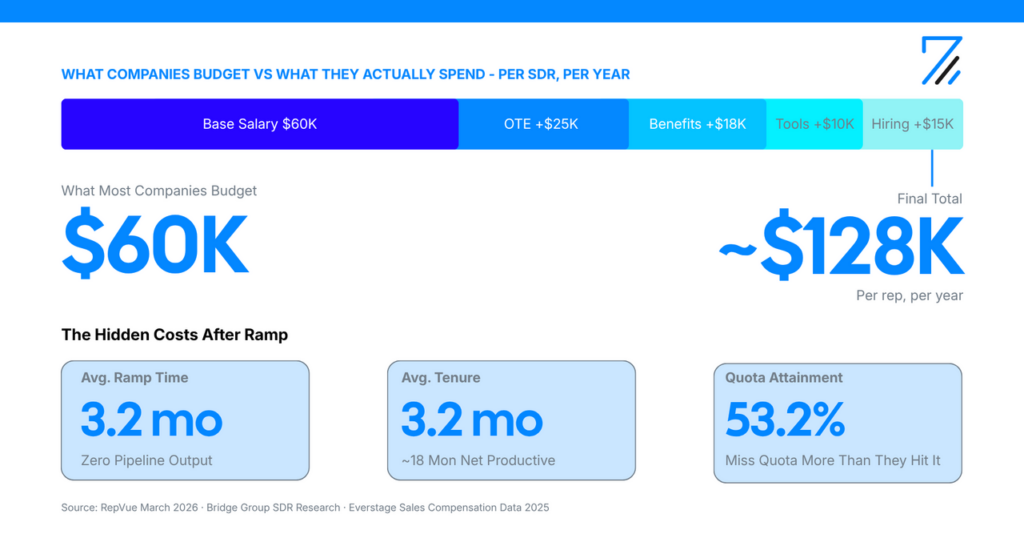
Add recruiting costs, onboarding time, management bandwidth, and the CRM infrastructure required to support the function, and a single in-house SDR can realistically cost between $110,000 and $160,000 annually in fully loaded terms. The $60K base salary? That's roughly 40–55 cents of every dollar you'll actually spend.
Most companies budget for the headline number and get surprised by everything underneath it.
Where Internal Outbound Breaks
The cost issue alone might be manageable if the return was predictable. But internal SDR programs don't just cost more than expected, they also take longer to produce results and break more often than the org chart suggests.
The ramp problem is real and getting worse.
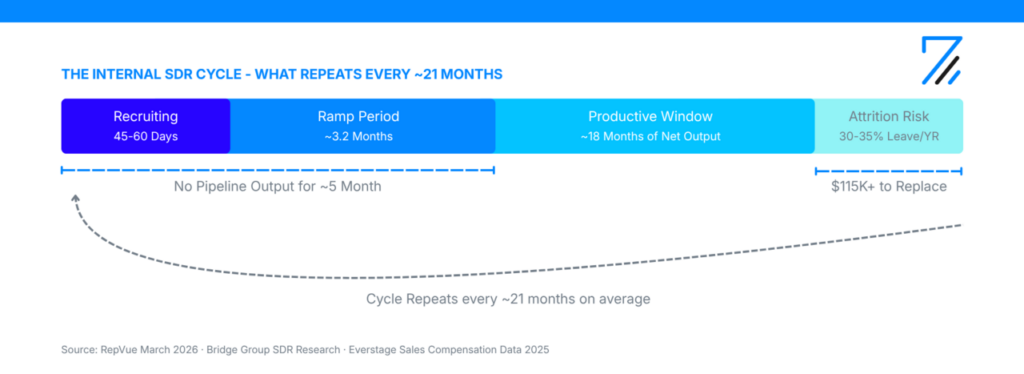
According to The Bridge Group's 2024 SDR report, the average SDR ramp time is 3.2 months. Three months of salary, benefits, and tool access before a rep is operating at anything close to full capacity.
For SaaS companies specifically, the report puts average ramp time at 5.7 months – up from 5.3 months in 2022 and 4.3 months in 2020, a 32% increase over five years.
Here's where it gets quietly painful: during that ramp window, you're also paying for the manager's time, the data costs, and the onboarding materials. None of that shows up on a comp calculator.
The tenure window is shorter than you think.
The same research puts average SDR tenure at just 1.8 years. Subtract a 3-month ramp period, and you're left with roughly 18 months of net productive output before the cycle starts again. That's not much runway before you're back in the recruiting process, absorbing another set of onboarding costs and another ramp delay.
Quota attainment is structurally challenged.
According to compensation data compiled by Everstage from Bridge Group research, the average SDR quota attainment rate sits at 53.2%.
Simply put: the typical in-house SDR misses their quota more often than they hit it. GTMnow analysis reinforces this, noting that approximately 52% of SDRs fail to reach 90% of their quota in a given period.
You're staffing and managing a function where the base rate for meeting expectations is a coin flip.
Turnover compounds every other problem.
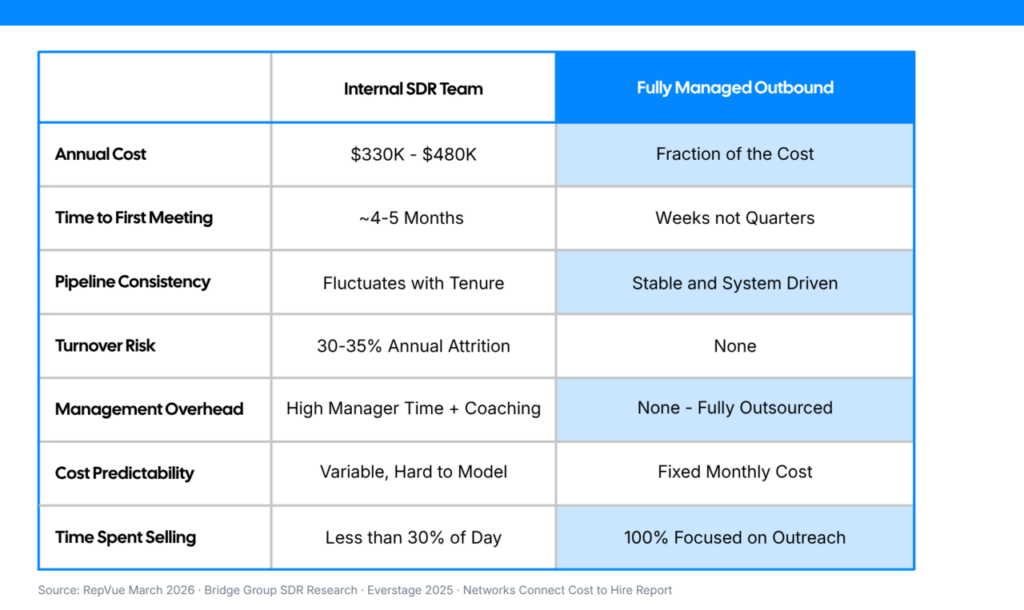
Annual SDR attrition runs at roughly 30–35% across the industry, based on the abovementioned Everstage research compilation. When a rep leaves, the total cost of replacement (including recruiting, training, and pipeline disruption) regularly exceeds $115,000 per departure. The revolving door isn't just expensive; it's destabilizing.
SDRs spend less time selling than you expect.
Salesforce's own sales productivity research shows that reps spend less than 30% of their time on actual selling activities. The rest disappears into CRM updates, research, scheduling, and internal admin.
That means a $110K+ investment in a rep is generating perhaps 30 cents on the dollar of actual prospecting effort.
Across the outbound programs we manage, removing that admin burden is often what unlocks the biggest early gains, not better messaging, not a larger list. Just more time pointed at actual outreach.
None of these individual problems is disqualifying on its own. Combined, they create a function that is expensive to build, slow to produce results, operationally demanding to maintain, and structurally prone to regression when any one of those variables goes sideways.
What Fully Managed Outbound Actually Includes
"Fully managed outbound" is a phrase that can mean very different things depending on who's selling it. At its best (and this is what Zeekeo's Launchpad engine is built to deliver) it means owning the entire outbound function as a unified, operational system, not just providing a tool or handling one channel.
Here's what that actually looks like in practice:
Data sourcing and hygiene.
A managed outbound engine doesn't start with a list you hand over. It builds from verified, enriched contact data, continuously cleaned and segmented by ICP. This matters because up to 70% of B2B contact data goes stale every year. Unclean data doesn't just waste messaging. It actively damages deliverability and sender reputation.
Multi-channel campaign architecture.
Effective outbound in 2026 isn't email or LinkedIn, it's both, but coordinated intentionally. Sequences should be designed to blend channels based on engagement signals, not static "Day 1, Day 3, Day 7" timing rules. When a prospect engages on LinkedIn but goes quiet on email, the sequence should adapt. When email deliverability metrics need attention, sending logic adjusts before damage accumulates.
Deliverability infrastructure and reputation management.
This is where most DIY and early-stage in-house programs quietly fail. Google's bulk sender guidelines require spam complaint rates to stay below 0.1% – a threshold that's easy to breach with uncontrolled volume or poor data quality. Managed outbound programs operate with dedicated sending environments, controlled warm-up protocols, and continuous monitoring against bounce rate thresholds (under 2%) and complaint thresholds (under 0.1%). This isn't optional infrastructure; it's what determines whether your messages reach inboxes at all.
Copywriting and campaign iteration.
Proper sequences are built, tested, refined, and improved based on actual performance data: reply rates, positive sentiment rates, engagement drop-off points. This is the work that most internal teams skip or deprioritize when they're under quota pressure, which is almost always.
Performance reporting.
Not vanity metrics, but actual pipeline signals. Which segments respond, which channel influences booked meetings, where sequences lose momentum, how reply sentiment trends across a campaign. This is the intelligence that allows an outbound program to compound over time rather than plateau.
For example, we’ve specifically worked with a client on improving not just pipeline (25% in their case), but also meeting show rates by focusing on pre-qualifying prospects.
What fully managed outbound does not include is the overhead that comes with employment: no payroll taxes, no benefits, no PTO coverage, no manager bandwidth consumed by coaching and retention. The function runs, and your team focuses on the conversations it generates.
Comparing CAC, Speed, and Consistency
The cost comparison between internal SDR teams and fully managed outbound comes down to three variables: cost of customer acquisition, time to first meeting, and consistency of output.
On cost, the math is fairly direct. An internal SDR team of three (a realistic minimum for meaningful coverage and redundancy against turnover) carries a fully loaded annual cost of roughly $330,000–$480,000. That includes salary, OTE upside, benefits, tech stack, recruiting amortized across typical tenure, and management overhead. A fully managed outbound program covers the same functional scope at a fraction of that cost, with none of the variable risk from turnover or underperformance.
On speed, there is no comparison. A managed outbound engine can be live and generating outreach within weeks. An internal SDR team requires a 45–60 day recruiting cycle followed by a 3+ month ramp.Industry benchmarks suggest filling a sales specialist role internally takes an average of 53–56 days, before onboarding even begins. For a growth-stage company, that's an entire quarter of missed pipeline opportunity before the function produces anything.
On consistency, managed outbound wins by design. Internal SDR output fluctuates with rep tenure, motivation, management quality, and attrition cycles. When a strong rep leaves, pipeline generation drops (sometimes significantly) until a replacement ramps. A well-built outbound engine doesn't have tenure cycles or motivation problems. It has systems.
When Done-For-You Makes the Most Sense
Fully managed outbound isn't the right answer for every organization. It's particularly well-suited for:
Companies that need pipeline growth sooner rather than later.
If you're in a growth phase, raising capital, or entering a new market, the ramp delay of internal hiring is a real cost. A managed program generates outreach activity in weeks, not quarters.
Organizations without a dedicated sales enablement function.
Internal SDR programs depend on strong management, playbooks, coaching cadences, and performance infrastructure. Without those things, even talented SDRs underperform. Most growth-stage companies don't have the bandwidth to build and run that infrastructure well. Outsourcing the function shifts the operational burden to a team that does this exclusively.
Companies that have tried internal SDRs and hit the attrition wall.
If you've cycled through multiple reps without building a durable pipeline, the problem is rarely the individual hires. It's the structural economics of the role. A managed program bypasses that loop entirely.
Agencies and SaaS companies scaling into new segments.
Testing outbound into a new ICP or vertical is expensive and slow with internal hires. A managed engine can run structured experiments across segments and return real signals within weeks.
Teams that want predictability.
Fully managed outbound converts a variable headcount cost – subject to turnover, OTE swings, and hiring cycles – into a predictable service engagement. For finance teams trying to model CAC and pipeline investment, that predictability has real value.
One client of ours wanted predictability in reaching decision makers, for a more stable pipeline, and by turning over their outbound to us, they managed to earn $250K in new revenue.
The Shift That's Already Happening
The broader market has been moving in this direction for a while. Deloitte's 2024 Global Outsourcing Survey of 500+ executives found that 50% are already outsourcing front-office functions including sales, and 80% plan to maintain or increase that investment going forward.
The reasons aren't surprising. Buyer behavior has changed: B2B buyers are almost done with their purchasing process before they engage with a vendor, which means outreach timing and relevance matter more than volume.
The operational complexity of running a compliant, multi-channel outbound program has increased substantially. And the talent market for SDRs remains expensive and unstable.
Against all of that, a fully managed outbound engine offers something the internal model structurally cannot: a predictable, scalable pipeline function that doesn't depend on how well you hired, onboarded, and retained entry-level sales talent in a competitive labor market.
A Direct Cost Comparison (Build It Yourself)
Before your next hiring conversation, run the actual numbers.
Estimate your fully loaded SDR cost: base OTE, employer taxes (roughly 7.65% for FICA), benefits (typically 15–25% of base for health, dental, 401k), recruiting (typically 15–20% of first-year comp), tech stack ($700–$1,400/month per rep), and management time (often 10–15% of a sales manager's capacity per SDR).
Then factor in expected ramp time (3 months of cost before productivity), expected tenure (18 months of net productive time), and expected quota attainment (roughly 53%, meaning the rep will miss quota more than half the time).
Then ask yourself: compared to a managed program that starts producing in weeks, costs a predictable monthly amount, and doesn't require you to hire, train, or manage anyone – which makes more sense for where your company is right now?
For most growth-stage agencies and SaaS companies in 2026, the answer is increasingly clear.
Ready to see what a fully managed outbound engine looks like for your pipeline goals? Compare the DFY vs. internal cost model at Zeekeo or book a call to walk through the numbers (we really like numbers and we’re very good at them) for your specific situation.
Subscribe to our blog
Lorem ipsum dolor sit amet, consectetur adipiscing elit. Pellentesque eget nunc finibus, venenatis purus eget, porta enim. Fusce a tempor diam, sed consequat purus.

Richard Lloyd
Richard Lloyd is the Chief Operating Officer at Zeekeo, the leading platform for B2B lead generation and multichannel outbound sales. With over 20 years of experience in customer success, account management, and operations, Richard focuses on building scalable systems that drive growth, efficiency, and exceptional client outcomes. He combines data-driven leadership with a commitment to quality and customer experience, ensuring every partnership delivers measurable value. When he’s not optimizing systems, you’ll find him cooking, baking bread, or hiking with Jasper, his spirited Fox Terrier.