
For years, the playbook was simple and straightforward: buy a list, plug it into an automation tool, send hundreds of LinkedIn connection requests (the more, the merrier), stack on follow-ups, and let volume do the heavy lifting.
A numbers game, we called it: if enough messages went out, meetings would eventually come back. The quality of those meetings? A topic for a different post.
In 2026, that “strategy” doesn’t just underperform, it can actively damage your pipeline and your name.
Today, the teams that consistently see solid results with outbound aren’t the loudest. They’re the most deliberate. They understand how to manage and ensure data quality, interpret and respect intent signals, protect deliverability, and design thoughtful multi-channel cadences.
For example, a study done by Backlinko and Pitchbox shows that personalized outreach improves response rates by up to ~32% compared with generic messaging. Meanwhile, average cold email reply rates hover anywhere from 1–5%, meaning most high-volume campaigns fail simply because relevance is missing.
DIY outbound isn’t dead, outdated, or suddenly a subpar option for lead gen. It’s simply more sophisticated.
Let’s look at what’s changed, and how to build a LinkedIn + email engine that scales without putting your accounts, domain, or brand at risk.
Why Old Automation Tactics Stop Working
The previous outbound wave rewarded consistent, high-volume activity. High daily sends and mostly static cadences, plus generic personalization (talk about an oxymoron).
That approach created short-term wins, at least in metrics, and it made teams feel like they’re putting in the work, but it also caused long-term problems.
Today:
- Acceptance rates drop when targeting is too broad and not well thought out.
- Engagement signals influence account health.
- Email providers aggressively monitor sender behavior, and penalize you when you overstep or show any kind of potentially risky sending patterns.
- Buyers instantly recognize templated messaging, and dismiss it.
Email providers now monitor sender reputation far more aggressively. According to Google’s bulk sender guidelines, spam complaint rates should stay below 0.1% and never exceed 0.3% or deliverability can deteriorate rapidly.
The tools you use are probably fine, but unstructured, messy, high-volume activity creates detectable patterns that do not match your genuine level of authority or relevance to a recipient.
When outreach feels robotic or rushed, engagement drops. When engagement drops, platforms notice, and restrictions follow.
At the same time, prospects are inundated with nearly identical messages with practically no substance or actual value: “Quick question.” “Noticed you’re in X.” “Open to a chat?”
If you rage-scream into a pillow the next time you see another “Quick intro” subject in your inbox, nobody will judge you. In fact, another reasonable course of action would be:

Image Credit: BBC's Blackadder, episode "Ink and Capability"
The real shift in 2026 isn’t about giving up outbound. It’s about upgrading how you build your own stack and your own strategy.
Think of it this way: your outbound motion should move from brute force to creative orchestration.
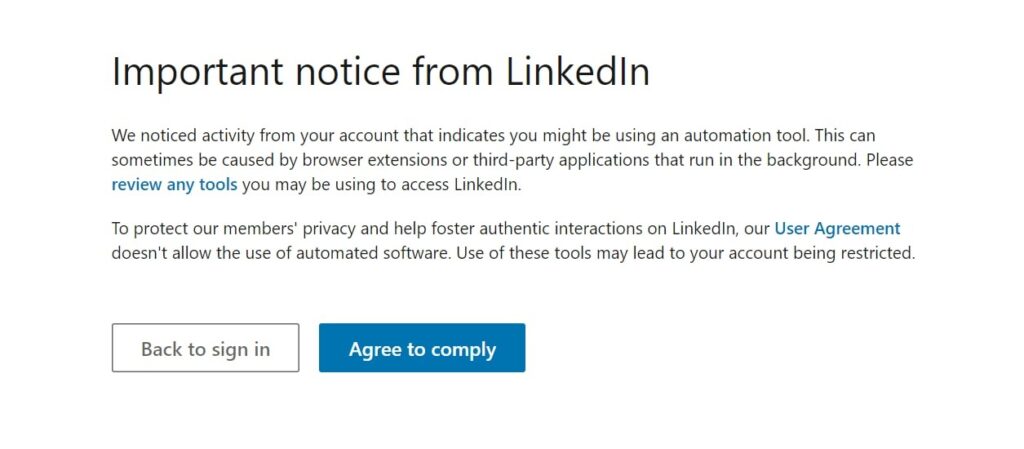
The Risks of Aggressive LinkedIn Activity
Source: https://getprospect.com/blog/linkedin-account-restricted
LinkedIn remains one of the most powerful networking and B2B channels, but it rewards you only up to a point.
Based on LinkedIn’s own Professional Community Policies, accounts may face restrictions when they exhibit activity patterns that resemble automated interaction or large-scale unsolicited messaging.
Here’s where teams still get into trouble:
1. Behavioral Spikes
Sudden surges in connection requests or message volume create patterns that don’t resemble normal user activity. Even if restrictions aren’t immediate, repeated spikes increase scrutiny.
Many sales engagement experts recommend gradually scaling connection activity to roughly 20–30 new connection attempts per day to maintain natural patterns. LinkedIn doesn’t give you exact numbers, but any behavior that seems unnatural and unjustified could lead to temporary restrictions.
2. Low Engagement Signals
If prospects consistently ignore, delete, or never respond to outreach, that lack of engagement becomes data. Over time, low-value interactions can impact account health and performance.
3. Generic Messaging at Scale
Personalization tokens aren’t actual personalization. Buyers can feel when a message is written “for anyone.” Relevance is now table stakes, not a bonus.
Research on cold outreach benchmarks shows that campaigns with advanced personalization roughly double reply rates compared with generic outreach.
4. Isolated Channels
Running LinkedIn outreach in isolation from email and data signals creates redundancy and missed timing opportunities. Without coordination, prospects may receive disconnected messages across channels, weakening your credibility.
The biggest risk today isn’t just platform penalties. It’s the erosion of the trust people put in your business and your own professional reputation.
If your outreach consistently feels automated or impersonal, reputation damage happens quietly, long before you see it in the actual numbers.
What the 2026 DIY Outbound Stack Looks Like
The modern DIY stack is less about stacking tools and more about designing layers that work together.
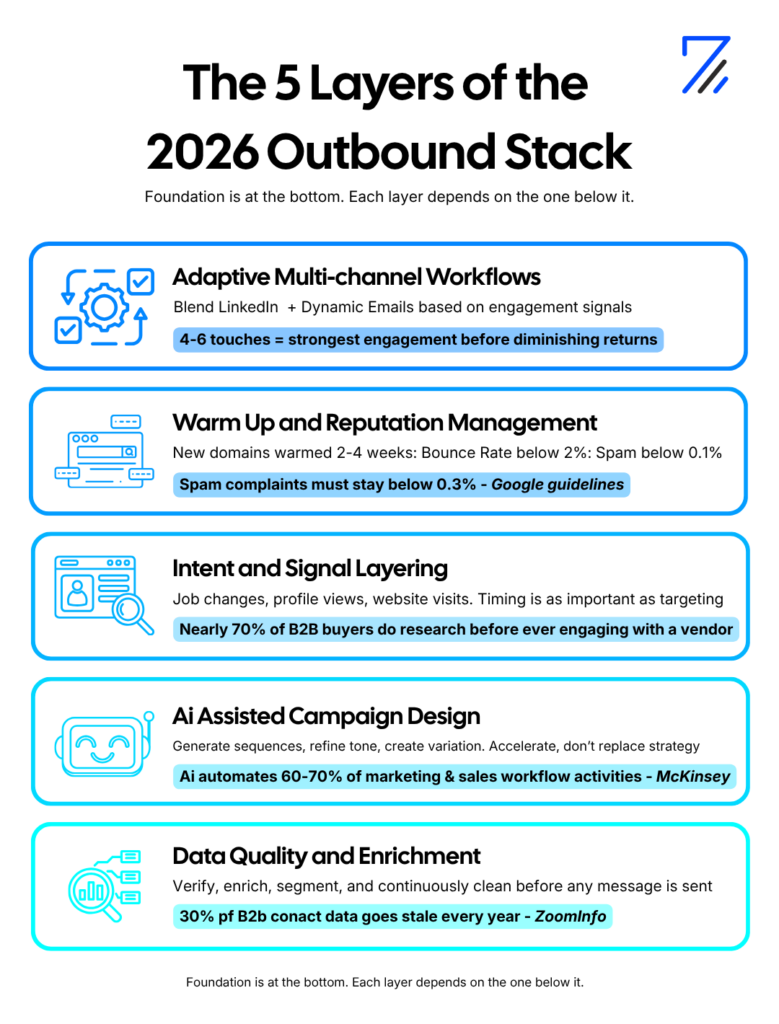
The most successful teams control five essential components.
1. Data Quality and Enrichment
Outbound begins before you write that email or LI message. According to ZoomInfo’s GTM report, up to 30% of B2B contact data becomes outdated every year, which means unverified lists can quickly damage deliverability and targeting accuracy.
In 2026, teams don’t just upload lists, they verify, enrich, segment, and continuously clean them.
That means:
- Validating email addresses before launch.
- Enriching contacts with firmographic and role-level accuracy.
- Filtering by tightly defined ICP segments.
- Removing inactive or disengaged prospects regularly.
Clean data protects deliverability. Enriched data improves relevance. Segmented data increases engagement.
Without this foundation, even Hemingway-level messaging underperforms.
2. AI-Assisted Campaign Design
Modern outbound isn’t about writing one template and copying it 1,000 times.
AI-assisted campaign builders now help teams:
- Generate structured sequences quickly.
- Refine tone and clarity.
- Create variations for testing.
- Analyze message sentiment and performance.
The key is not replacing human-led strategy, it’s accelerating it. According to McKinsey’s research on AI, marketing and sales workflows automate anywhere from 60-70% of activities, which means your team can focus on more nuanced, strategic aspects of outreach.
AI supports the process by suggesting structure, tightening copy, and identifying weak spots. The strategy still belongs to the team. In fact, the team can devote more of their time to strategy and ideation with this aspect of output handed over to AI (with supervision, of course).
This combination allows personalization to scale without becoming mechanical.
3. Intent and Signal Layering
Timing has become as important as targeting.
Instead of placing every contact into the same cadence, modern stacks account for signals such as:
- Profile engagement.
- Website visits.
- Recent job changes.
- Company growth events.
When signals influence sequencing, outreach feels contextual instead of random. Research shows that B2B buyers are already about 70% through their purchasing research before they engage with vendors, and in many cases they initiate the first contact themselves. This just shows why outreach that aligns with active research signals is far more effective than untimed cold messaging.
Intent transforms outbound from just another interruption into relevance people can appreciate.
4. Warm-Up and Reputation Management
Email performance is infrastructure.
In 2026, responsible teams:
- warming new domains over 2–4 weeks before scaling volume
- spread sends across inboxes
- keeping bounce rates below 2%
- maintaining spam complaints below 0.1%
Dedicated sending environments, controlled pacing, and compliance-aware systems reduce risk and protect long-term performance.
Outbound isn’t just about pushing your systems to send as many campaigns as possible, it’s about making your process sustainable and repeatable for the long haul.
5. Adaptive Multi-Channel Workflows
Rigid “Day 1, Day 3, Day 7” cadences are quickly fading.
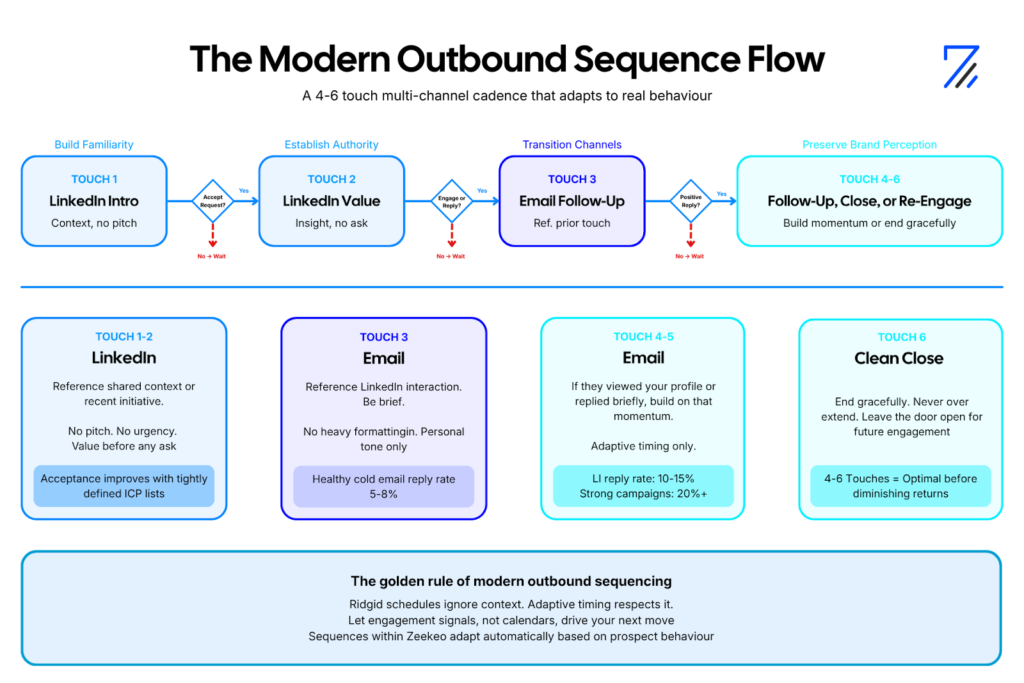
Instead, sequences blend LinkedIn and email dynamically. For example:
- Start with a thoughtful LinkedIn introduction.
- Add value before making an ask.
- Transition to email if engagement stalls.
- Adjust follow-ups based on response signals.
In our experience, sequences with 4–6 touches tend to produce the strongest engagement before diminishing returns appear. The difference is subtle but powerful, and it will certainly be reflected in performance and perception.
Modern outbound adapts. It doesn’t blindly execute.
How Zeekeo Operationalizes the Modern Outbound Stack
The five components we talked about above only work when they operate as a unified system.
In practice, most teams run them in silos: separate data tools, disconnected sending environments (which sometimes means your poorly paced cold emails suddenly make your weekly newsletter land in spam), and analytics that don't talk to each other. That fragmentation is where outbound programs break down.
Zeekeo's engine, Launchpad, was built specifically to operationalize this philosophy: controlled pacing, signal-based sequencing, reputation protection, and adaptive workflows, all running from a single environment.
In the simplest possible terms, it works as a unified outbound engine.
Centralized Signal Visibility
The most common failure point in multi-channel outbound isn't bad messaging, it's disconnected data.
When LinkedIn activity, email engagement, and prospect behavior live in separate systems, teams lose the context they need to sequence intelligently. Outreach either overlaps, arrives too early, or misses the window entirely.
Launchpad aggregates engagement signals across channels into a single view, so teams can see when prospects are interacting and where conversations are gaining traction.
This allows sequences to adapt based on real behavior rather than static timing, and it eliminates any overlap, redundancy, and creates a more natural progression from introduction to conversation.
Controlled Pacing and Reputation Protection
Behavioral spikes (remember those bulk invites and bulk emails we mentioned?) are one of the fastest ways to trigger LinkedIn restrictions and email deliverability issues. The problem is that manual pacing is time-consuming, easy to get wrong under pressure, and often the first thing that slips when a team is scaling activity.
Launchpad enforces structured pacing and sending logic designed to maintain healthy outreach patterns, so you don’t have to waste hours of your time doing it manually.
This helps teams scale activity without creating the behavioral spikes that typically trigger restrictions or deliverability issues.
AI Campaign Assistant
Building sequences that are structured and genuinely useful to prospects takes so much time. Without support, teams either default to generic templates (hello, Nepal), or spend too much time on copy at the expense of strategy.
Launchpad’s AI campaign support helps teams build sequences faster while maintaining quality. It assists with message generation, structure, and refinement, without stripping away human context.
Campaign creation becomes strategic rather than purely manual.
Real-Time Performance Insights
In this post-volume era, knowing that messages went out just isn’t enough. Teams that improve consistently are the ones that can see exactly where engagement drops, which segments respond, and how sentiment shifts across a sequence.
Outbound success depends on intelligent iteration that always takes into account more than just numbers.
Launchpad provides visibility into:
- Which steps drive replies.
- Where engagement drops.
- Which segments outperform.
- How sentiment trends over time.
Instead of guessing why performance shifts, teams can respond with data and iterate with purpose.
DIY doesn’t mean unstructured, on the contrary. It means contained, but creative.
Best Practices for Multi-Channel Sequencing
Image created by Launchpad.
A safe and scalable outbound system is, above all, intentional.
Start with Context, Not a Pitch
On LinkedIn, initial outreach should feel natural and relevant. You can reference shared industry context, a recent initiative, or a mutual connection point.
The first touch builds familiarity, not urgency.
Provide Value Before Asking for Time
Instead of immediately requesting a call, offer insight, knowledge, perspective. Share an observation about their space, or ask a thoughtful question to start a meaningful conversation.
Conversations start when prospects recognize your authority in the field and feel that there is value in what you have to share.
Transition Channels Strategically
If LinkedIn engagement slows, a concise email referencing the earlier interaction can reintroduce the conversation (or vice versa).
Keep it brief, as personal as possible, and avoid heavy formatting.
Multi-channel coordination increases visibility without increasing pressure. People are already swamped with notifications, it’s reasonable to assume they might have just missed your earlier message, or they delayed responding until they had more time. And then it slipped their mind. We’ve all been there.
Design Flexible Cadence Windows
Allow engagement signals to influence timing. If a prospect views your profile or replies briefly, it’s safe to use that to build momentum.
Rigid schedules ignore context, but adaptive timing in your campaigns respects it.
Close Sequences Cleanly
Well-designed sequences typically include four to six meaningful touches. But flexibility is important, here, too. Sometimes two emails are enough, and sometimes you might need to level up your LinkedIn posting game for those DMs to make sense.
Ending gracefully, rather than overextending, preserves brand perception and keeps doors open for future re-engagement.
What to Measure in a Post-Volume Era
In 2026, activity metrics are secondary. What matters more now:
Acceptance-to-Conversation Rate
Are accepted connections turning into actual exchanges? If not, messaging needs refinement, otherwise you’re likely wasting your team’s time.
Once you’re actually connected, LI messages typically generate reply rates around 10–15%, with stronger campaigns exceeding 20%, meaning only a portion of accepted connections ultimately turn into active conversations.
Positive Reply Rate
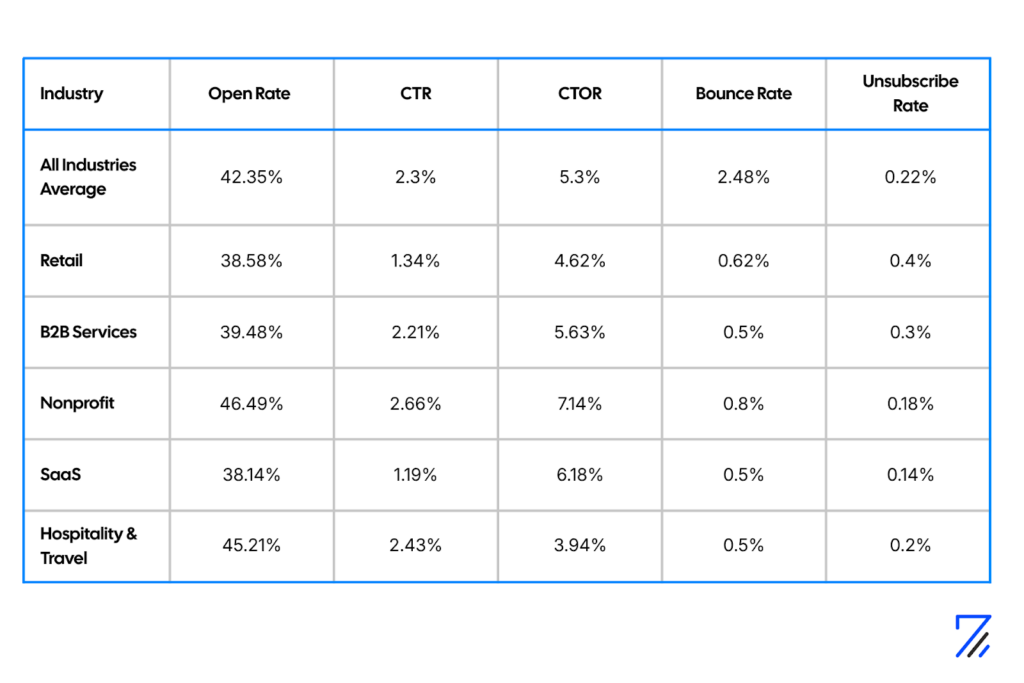
Track responses that indicate real interest, not just automated replies or polite declines. Healthy cold email campaigns typically see 5–8% reply rates, with only a fraction converting to actual meetings. However, even rejections can help you understand your prospect’s state of mind and improve your campaigns based on that knowledge.
Another thing to keep in mind: your industry and your audience. Sometimes what we think of as a benchmark might not apply to your niche, so it’s worth adjusting your expectations based on the reality in which you operate.
Source: https://blog.hubspot.com/sales/average-email-open-rate-benchmark
Deliverability Health
Monitor bounce rates, sender reputation, and spam flags. These metrics protect future performance as well as your overall brand image.
Healthy outbound campaigns typically maintain:
- bounce rate under 2%
- spam complaints under 0.1%
We might be getting a tad repetitive here, but it’s very, very important to remember these numbers – and hopefully never, ever see them in your own reports.
Engagement Trends
Look for patterns in sentiment, reply timing, and drop-off points. Nuance can help you fine-tune your content as well as your cadence.
Pipeline Impact
Ultimately, outbound must contribute to revenue. Which segments convert? Which channel influences booked meetings? Where does velocity improve?
Volume once felt impressive, but today, companies care more about measurable impact. It may sound as if it’s purely about “the bottom line”. However, it’s more about putting your time towards activities that convert and contribute to your growth, instead of wasting it on lost causes.
The Shift from Automation to Orchestration
The most important mindset change for 2026 is this:
Outbound is no longer about pushing more messages into the market. There’s too much noise anyway.
It’s about orchestrating controlled, compliant, meaningful conversations.
Data informs targeting, AI accelerates quality, and your infrastructure protects your reputation. Insights that you collect along the way will refine your campaign execution.
DIY outbound doesn’t mean reckless experimentation. It means owning your growth engine, with structure at the heart of everything you do.
The teams that thrive will be the ones that combine pacing, analytics, and compliance into a unified system that leaves room for genuine personalization.
Is Your Automation 2026-Ready?
Before scaling further, ask yourself:
- Is your outreach paced responsibly?
- Are LinkedIn and email coordinated intentionally?
- Do you monitor deliverability health consistently?
- Is AI supporting personalization without replacing authenticity?
- Can you see exactly where conversations stall, and why?
If any of those feel unclear, your stack may be operating on an outdated playbook.
Outbound isn’t disappearing, but high-risk, volume-first outreach is. Good riddance, we’d say.
The next generation of growth belongs to teams who build structured, intelligent, omni-channel systems that scale conversations beneficial to all parties involved, without scaling risk.
Subscribe to our blog
Lorem ipsum dolor sit amet, consectetur adipiscing elit. Pellentesque eget nunc finibus, venenatis purus eget, porta enim. Fusce a tempor diam, sed consequat purus.

Richard Lloyd
Richard Lloyd is the Chief Operating Officer at Zeekeo, the leading platform for B2B lead generation and multichannel outbound sales. With over 20 years of experience in customer success, account management, and operations, Richard focuses on building scalable systems that drive growth, efficiency, and exceptional client outcomes. He combines data-driven leadership with a commitment to quality and customer experience, ensuring every partnership delivers measurable value. When he’s not optimizing systems, you’ll find him cooking, baking bread, or hiking with Jasper, his spirited Fox Terrier.
