



Signal-based outbound is the real growth lever in outbound. Full stop. There are just too many numbers backing this up to not say it outright.
One of the topics we discussed recently was about the changing nature of email marketing and how to work within this new framework. Mailbox providers cap the number of emails that can be sent per day, meaning volume-focused approaches to outbound don’t hold up well anymore. That means that a methodical, tactical approach to who you’re emailing and when you email them is critical.
The 2026 growth lever is sending fewer messages to better-qualified prospects and being more particular about when to pull the trigger. When properly executed, this translates into a massive improvement in email reply rates, ultimately opening the door to more conversions.
What signal-based outbound actually means
So what is signal-based outbound? It’s essentially in the name.
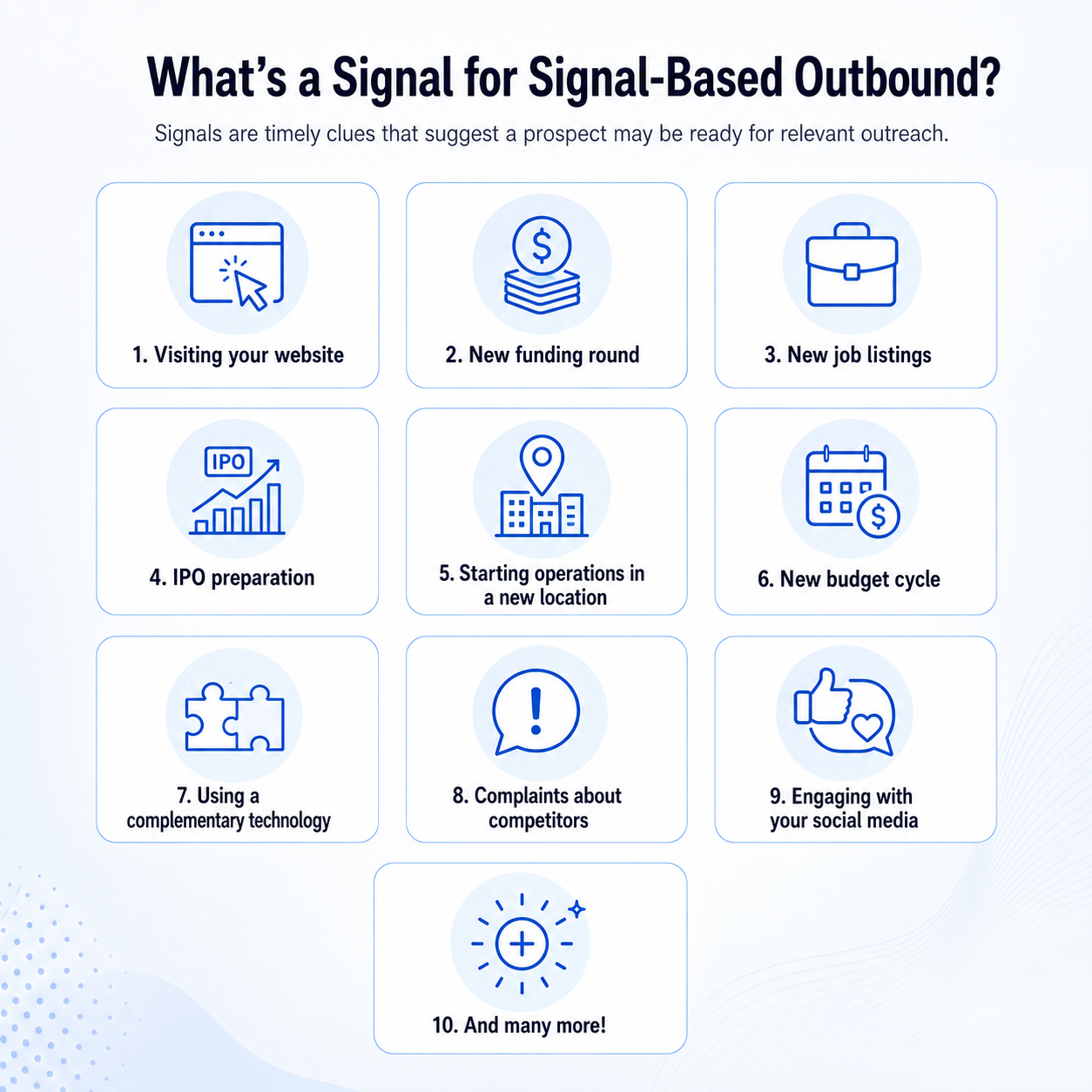
Signal-based outbound is the process of initiating outbound marketing in response to signals of increased buying interest from a prospect. What constitutes a “signal” can vary between different roles and different products, but common examples include visits to your website, posting new job listings, and announcing new funding rounds.
These signals don’t necessarily need to come from the prospect, either. If you see your direct competitors suddenly swarming a target, that can be a signal, too.
The key is that signal-based outreach should at least partially replace the practice of maintaining a fixed outreach schedule for your lists. Timely, contextual touches are more relevant to the prospect and are more effective at garnering replies as a result.
As stated, the numbers show this is an absolute game-changer for driving results. According to Salesmotion, the average cold email reply rate is around 3%, while signal-based campaigns are between 15% and 25%. That works out to being at least five times more effective at yielding a reply than sending a cold email.
Why “more” stopped working
For a long while, marketing teams could mask bad habits with sheer volume. Something we discussed previously in relation to personalization was that click-through rates on cold emails are universally low, regardless of business type. Many worked around this by just sending more cold emails to more people.
That no longer works for either the business or the customer.
On the technical side, deliverability ceilings now punish high-volume senders. Mailbox providers like Gmail and Zoho have always prioritized the user experience of the receivers of emails rather than the senders, and that has been skewing further over time. Senders can only send a certain number of emails per day, and ignoring that will be punished. That includes your email accounts, and even domains, being regarded as spam.
On the customer side, the buyer’s journey has changed over time in a way that makes cold, formulaic outreach less effective. There are plenty of statistics that speak to this:
- B2B buyers are 57% to 70% through their buying research before contacting sales
- 90% of B2B buyers say online content has a moderate to major effect on purchasing decisions
- 67% of the buyer’s journey is now done digitally
- 84% of CEOs and VPs use social media to make purchasing decisions
- 62% of B2B buyers say a web search was one of the first three resources they use to learn about a solution
Buyers research new products silently and will often initiate conversations on their own if they’re interested. Generic outreach will almost always be ignored.
Finally, there’s the operational reason it doesn’t work. More volume means less targeting, which means a lower chance of conversion. Even if your outreach to these prospects turns into a meeting, it’s highly unlikely that the meeting ends with a handshake. When that happens, it just means your AE wasted their afternoon.
Building a signal-led engine
The quantitative and the qualitative data both point to signal-led outbound being impactful, but how do you actually execute on that?
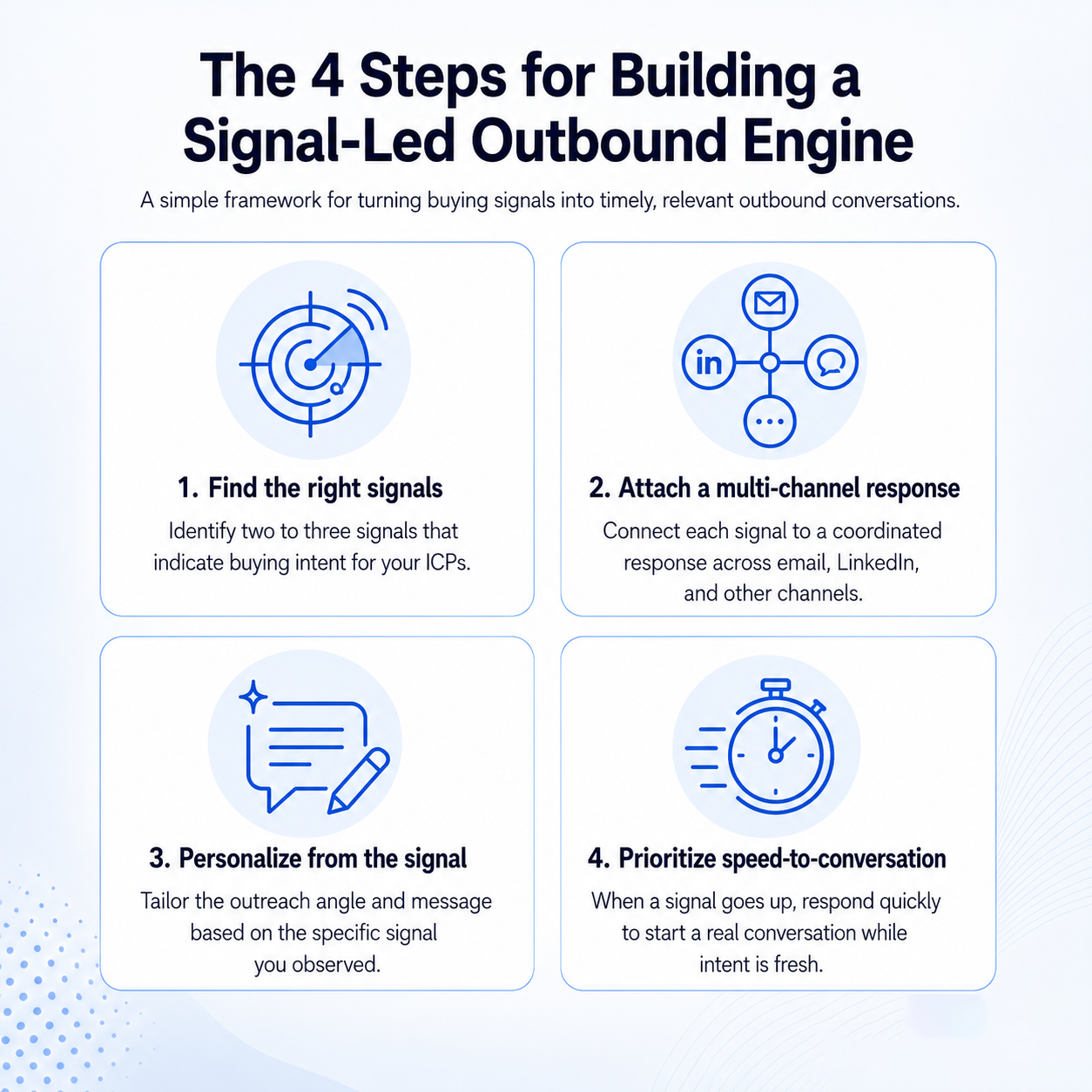
The first step is to actually figure out the right signals to act upon. This will vary based on the industry you’re in, what your product is, and your ICP. Figuring out the best signals to focus on may be a process that requires some trial and error.
Once you decide on the signals, the next step is attaching those signals to a multi-channel response. Email is important, but we’ve seen that touching base with prospects on LinkedIn or other social media channels is important as well. Depending on the situation, a call may even be appropriate. Regardless, having that signal-led outreach come across multiple channels is key.
As for the messaging itself, move past generic personalization tokens and focus on the signal itself. Personalization that references what the prospect actually did to spark this outreach can help lead to conversations, which can push a prospect down the funnel.
Finally, make sure that this is executed quickly and effectively. Speed-to-conversation remains one of the key metrics to track in marketing, and that’s still the case here.
Signal-led outbound is an operating discipline, not a tool
Signal-led outbound isn’t a tool, a trick, or a “hack.” It’s a new operating discipline that businesses need to incorporate into their outbound efforts.
This may represent a big shakeup for some sales teams. We’ve worked with plenty of clients who are reluctant to dial back on their volume-focused outbound, but this is becoming less tenable as time goes on. Fewer, sharper touches boost reply rates while protecting deliverability in your colder outreach.
Smaller businesses might encounter issues with their team’s bandwidth and availability, where strong signals might get missed as SDRs tackle other work. Done-for-you outbound helps turn scattered signals into a repeatable workflow that can boost your business’s bottom line.
Book a Zeekeo Launchpad strategy session, and we will map the buying signals your outbound should be acting on.
Share this post: