





The instinct for outbound marketing has always been straightforward; send more to get more. It’s logical and used to work back in the day, but that approach can now inadvertently kill your domain.
Deliverability experts now cap warmed mailboxes at roughly 30 to 50 sends per day. More than that runs a real risk of your emails not actually getting delivered. Prospeo and many others estimate that roughly one in six cold emails that are sent by SDRs get flagged as spam and wind up never being seen as a result. This represents a major shift for revenue teams, and it’s something that demands an immediate response from your team.
What actually changed in B2B email marketing that made deliverability harder?
Changes in how spam filters work and the introduction of specific deliverability requirements have led to many legitimate B2B cold emails being erroneously flagged as spam.
The statistics for this aren’t pretty when you look at them, according to Email Tool Tester:
- 83.1% email deliverability rate across 15 tested mailbox providers
- 16.9% of all emails never reach the intended recipient’s inbox
- On average, 10.5% of emails end up in the intended recipient’s spam folder
- 6.4% of emails go missing altogether and are considered “undelivered”
This can significantly reduce the impression count and open rates of your email marketing efforts. Worse yet, sending more emails to account for this can completely stifle outreach.
Previously, this would have been seen as an issue with the copywriting. The best approach was avoiding “spammy” keywords, effectively personalizing the opener, and being conservative with how many links were included.
That playbook is now outdated.
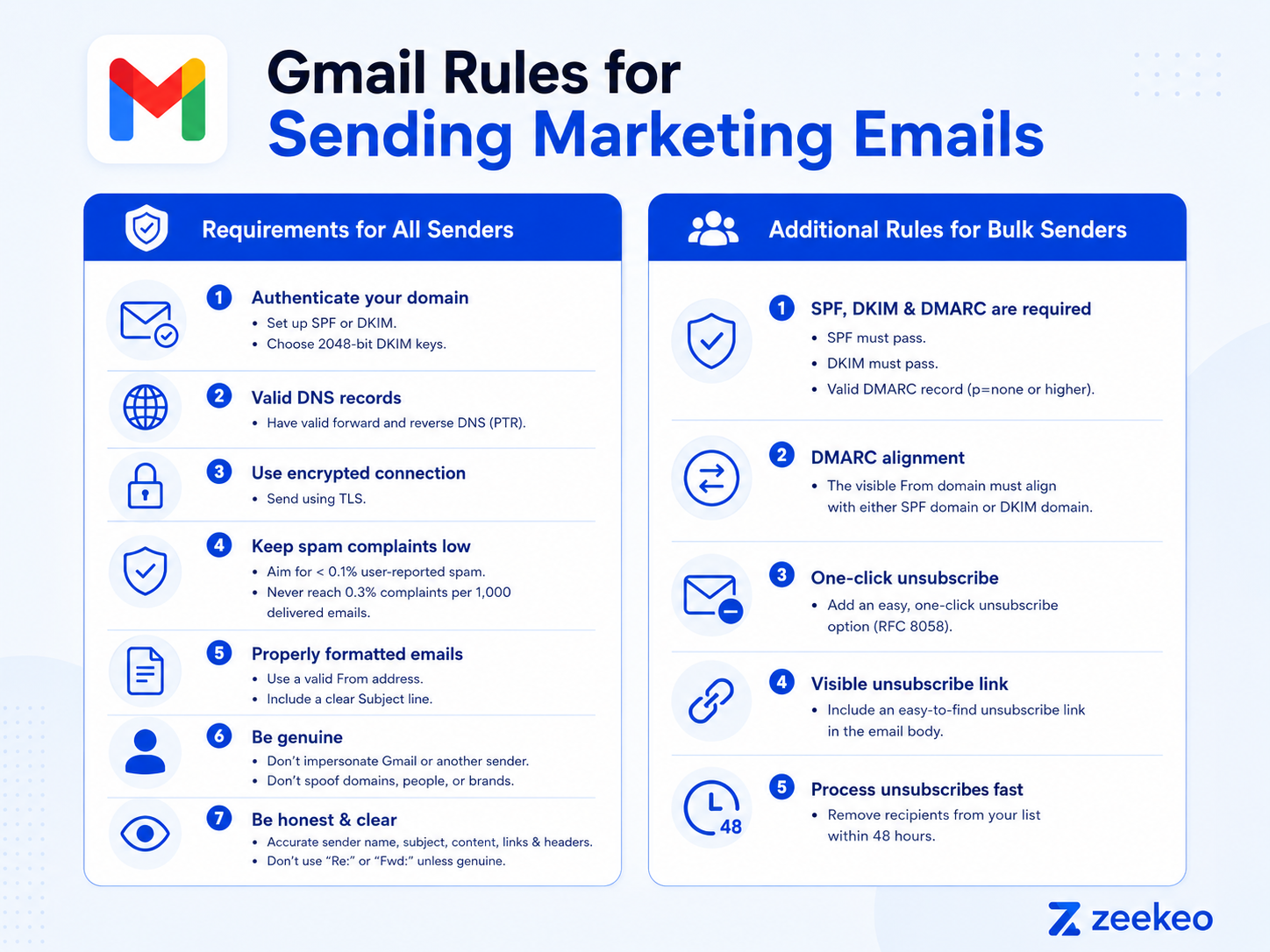
Inbox placement is now a matter of trust and user experience for the email recipient. Mailbox providers aren’t looking at whether your email sounds promotional, they’re deciding whether your domain deserves to be seen in the first place. Authentication, sender reputation, list quality, engagement and complaint rates now matter more than being particular about how the email is written.
In the same vein, SPF, DKIM and DMARC are no longer technical housekeeping. Different mailbox providers have very specific requirements for senders that are, essentially, made to make cold emailing harder. Running afoul of Google’s email sender guidelines or Yahoo!’s sender requirements can carry serious consequences.
The same is true for unsubscribe and complaint management. One-click unsubscribe and low complaint rates are now requirements, not optional features. If complaint rates run too high, if people can’t easily unsubscribe, or if their efforts to unsubscribe don’t register quickly enough, it’s a big problem for you.
Because of this, increasing volume has gone from “scale” to “self-sabotage.” The companies still bragging about how many emails they can send are missing the point. Modern outbound belongs to teams who send responsibly and protect their domain trust.
The Real Cost of Ignoring the Ceiling
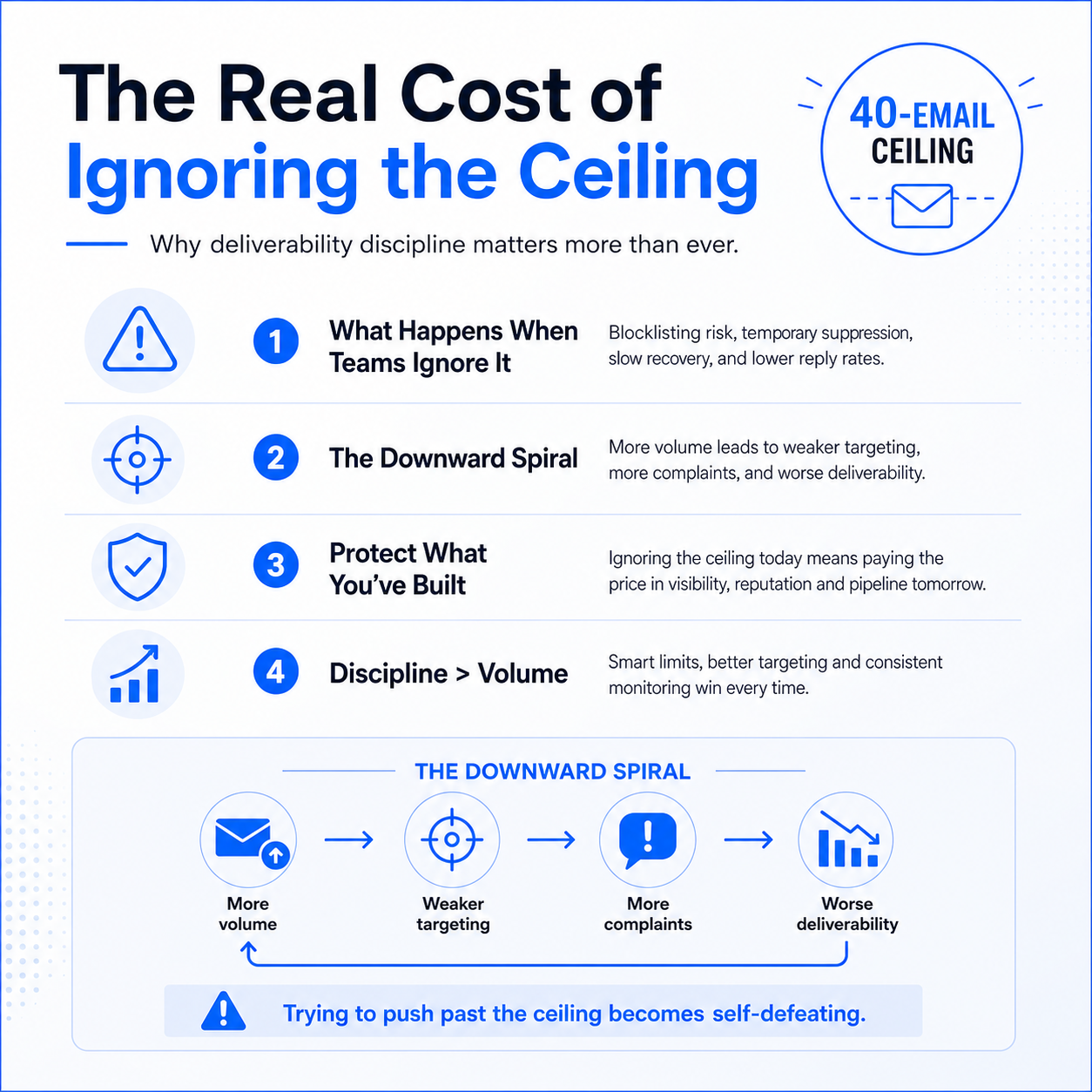
Ignoring the ceiling on how many emails you send or brushing off sender requirements for major mailbox providers carries real consequences. No, really. Existential consequences.
Blocklisting is a real possibility. This sees your email account or domain being flagged as suspicious by spam detectors. The best-case scenario is that you get put in the doghouse for a few weeks. The worst-case scenario? A burned domain where you and all other email accounts attached to that domain are flagged as spam for an indefinite period of time.
If this happens, recovery doesn’t come quickly or evenly. Remember, different businesses are running different mailbox providers and may have extra security systems attached to their email accounts. This means that even if Gmail lets you get back to it, Zoho, Yahoo!, Microsoft, GoDaddy and Hotmail may not be so forgiving.
If you continue down that hole of increasing volume, it’s ultimately a self-defeating approach regardless. Chasing volume inevitably leads to worse targeting, which results in worse reply rates.
Long story short? Don’t try and cheat your way past the ceiling, or else.
How High-Deliverability Teams Operate Now
If you’re achieving high levels of deliverability, that’s something that now needs to be actively protected. That means maintenance and vigilance. The consequences of not doing so are just too high to play around with.
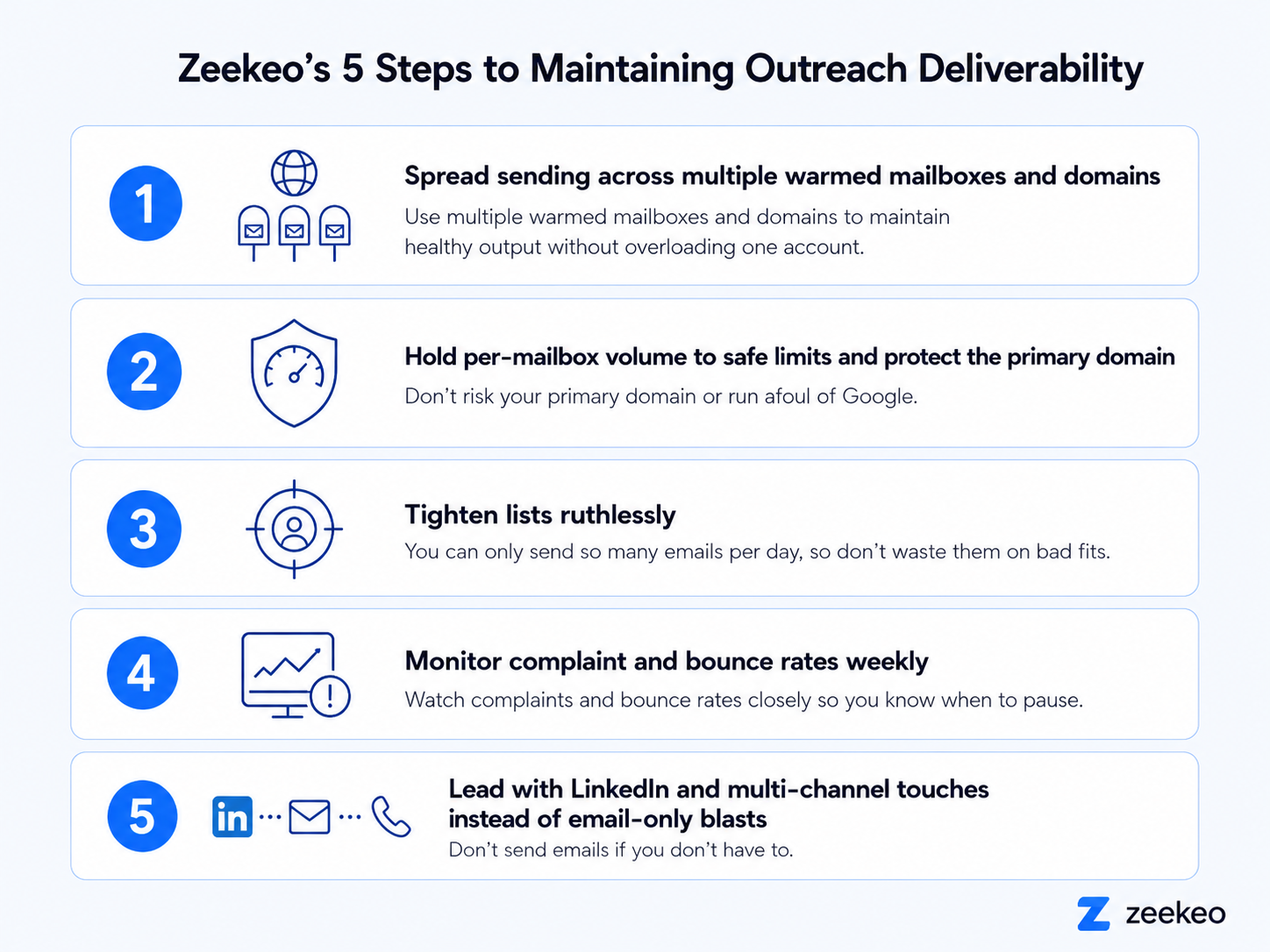
The best starting point is to avoid doing cold email outreach where possible. Lead with LinkedIn and multi-channel touches instead of email-only blasts. This opens the door for better personalization and better first impressions, while also allowing you to preserve your daily email allotment.
When you’re actually sending emails, it’s a matter of balancing volume across your domains.
Spread your emails across multiple warmed mailboxes while holding your per-mailbox volumes within safe limits. Doing this significantly reduces the chances of either your email addresses or your domains being blocklisted. Also avoid using your primary domain where possible, to keep its reputation as safe as possible from spam filters.
While it’s important to be careful with how you’re sending emails, it’s also important to take care with who you’re sending to. Tighten your lists ruthlessly and monitor complaint and bounce rates weekly.
Again, the stakes are too high here to not be careful.
Infrastructure Is a Strategy, Not a Setting
Deliverability isn’t a minor concern anymore. In 2026 and beyond, it’s an operational discipline that needs ownership, monitoring, and careful maintenance. There isn’t any kind of shortcut you can do, except for having done-for-you outbound services tackle it for you.
Done-for-you outbound marketing bakes in the infrastructure for email outreach that most teams have to trial and error their way through, likely resulting in some lumps along the way. Fewer and better-placed emails beat spray-and-pray volume every time, and having that methodical approach is an area where Zeekeo thrives.
The 40-email ceiling is not a limit on growth. It is a forcing function for better targeting. Teams that respect it protect their reputation and their pipeline, and those that don’t will be forced to sit and wait for weeks at a time.
Book a Zeekeo Launchpad strategy session. We’ll audit your outbound infrastructure and volume before Gmail’s spam filter does it for you.
Share this post: