

There's a version of lead generation that still lives on in many company decks, sales hiring plans, and Monday morning pipeline reviews. It looks something like this: hire SDRs, build a list, run outreach, measure activity, report "leads generated," and hope the number is substantial enough to keep the conversation going until the end of the quarter. Fingers crossed and all.
That version is running out of road.
Not because outbound no longer works, but because the model underneath it (the one that treats pipeline as a production problem rather than a systems problem) has fundamental cracks that volume alone can no longer paper over.
In 2026, the teams pulling away aren't the ones sending more. They're the ones who have replaced lead generation with something more complete: a managed acquisition engine designed to produce outcomes, not outputs.
Why Legacy Lead Gen Models Are Breaking
For a long time, B2B lead generation was a reasonably simple machine. You defined a rough ICP, built or bought a list, hired reps to work through it, and tracked activity metrics as a proxy for progress. Calls made. Emails sent. Meetings booked. All the boxes ticked. Enough motion created enough momentum, and some percentage of that momentum became revenue.
The math worked because buyers had fewer ways to self-educate, fewer alternatives to choose from (or even build on their own with AI), and fewer touchpoints competing for their attention. Outbound continued to work because sellers had disproportionately more information to work with than buyers.
That "knowledge asymmetry” is gone.
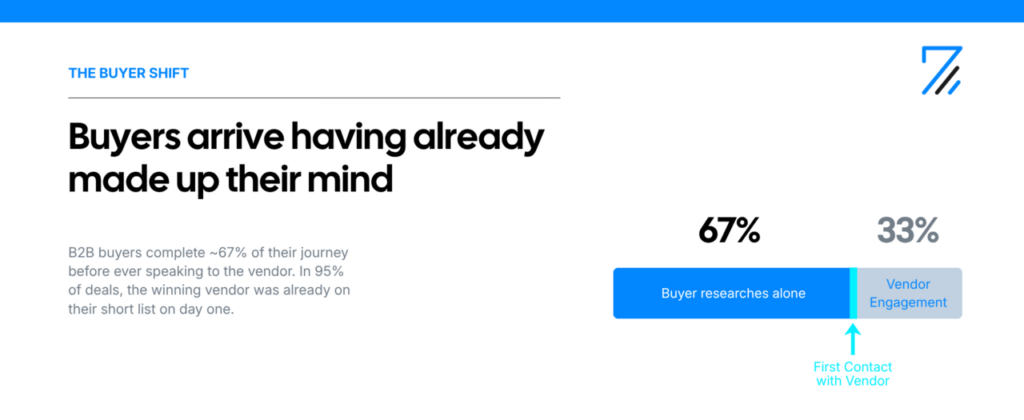
According to 6sense's 2025 Buyer Experience Report, B2B buyers now progress roughly two-thirds of the way through their purchasing journey before they ever engage with a vendor. In 95% of cases, the winning vendor was already on the buyer's shortlist on day one of their research process. At that point, not only do they know what they want, but they know why they do or do not want your product/service perfectly clearly.
Not after a sequence of emails. Not after a discovery call. On day one, before your SDR ever sent a message.
What that means in practice is that traditional outbound, operating in isolation from brand presence, content, and intent signals, frequently reaches buyers too early or too late, with messaging that's too generic, through a channel they didn't ask to be contacted on.
The result? 80% of B2B leads generated by legacy models never convert to customers.
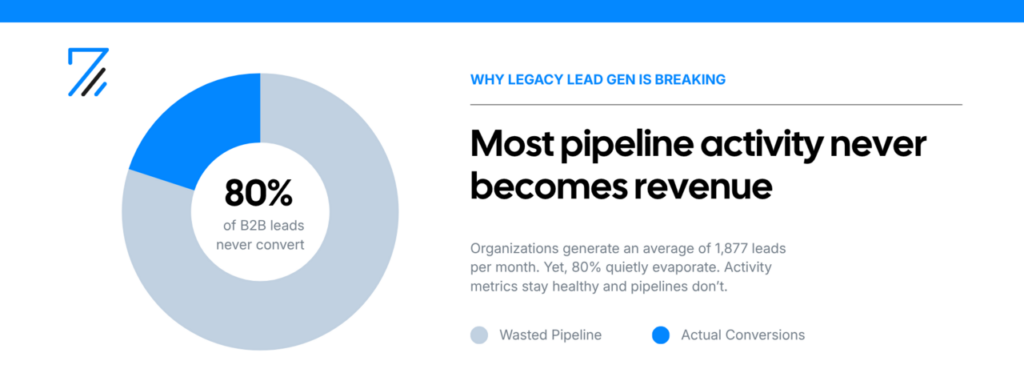
Organizations generate an average of 1,877 leads per month, and most of that volume quietly evaporates. Activity metrics stay healthy. Pipeline doesn't.
We see this consistently across the programs we take over: companies arrive with healthy send volumes and open rates they're proud of, and a pipeline that hasn't moved in a quarter.
There are structural cracks in most outbound setups that go well beyond messaging.
The Buyer Shift Toward Outcome Ownership
There's a broader shift happening in how sophisticated B2B buyers think about engaging with other businesses, and it mirrors what's happening in how their own customers buy from them.
The buyers of GTM services are no longer satisfied with deliverables that stop at the activity layer: "Here's your lead list. Here are your outreach sequences. Here are your email open rates." They want to know what happened next: Did those contacts become conversations? Did those conversations flow straight into the pipeline? Did that pipeline become closed revenue?
This shift toward outcome ownership isn't a preference: it's a response to market reality.
Running an SDR team requires a hefty commitment, not just in terms of budget, but also in terms of hiring, onboarding, training, and retention (SDR turnover is notoriously high across most industries). Not to mention proper integration, where your marketing and sales teams communicate well enough to focus on the right prospects at the right time.
Against that backdrop, "we generated 200 leads this month" is no longer a satisfying answer. The question being asked instead is: how many qualified conversations did we create, what did they cost, and how much revenue did they produce?
That's a fundamentally different accountability model, and it demands a fundamentally different kind of partner (if outsourced).
What an Acquisition Engine Includes in 2026
The term "lead generation" implies a single output: a list of names and contact details.
An acquisition engine implies something more complete: a connected system of inputs, processes, and feedback loops that produces revenue-relevant outcomes at scale.
In 2026, the components of a well-functioning acquisition engine include:
ICP definition and enrichment
Not "we target companies with 50–500 employees in SaaS," but a tightly scoped, continuously refined profile built on firmographic data, technographic signals, behavioral patterns, and real purchasing history. A large portion of B2B contact data becomes outdated every year, which means any acquisition engine without active data hygiene is operating on a degrading foundation from the moment it launches.
Intent and signal layering
Modern acquisition isn't about reaching everyone in your ICP on the same cadence. It's about reaching the right accounts at the right moment. Companies using intent data report 40% shorter sales cycles and three times more qualified opportunities compared to those relying on static lists alone. Intent doesn't replace outreach, it tells you who to prioritize and when.
For example, in our work with a fleet management company, refining ICP segmentation by likely use case (rather than broad industry) was the single change that drove a 24% lift in positive reply rates.
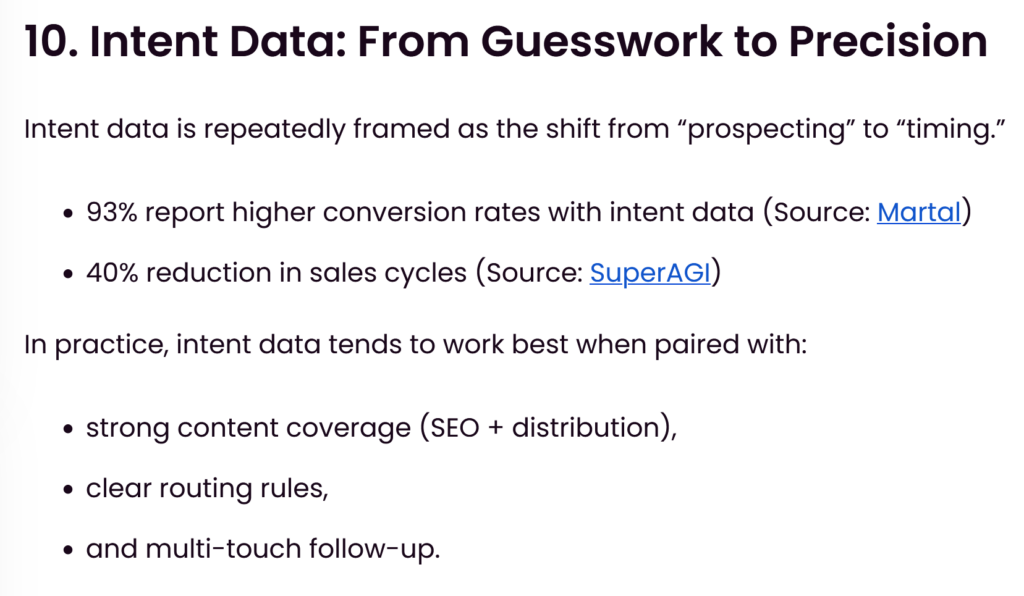
Source: https://www.cirrusinsight.com/blog/lead-generation-statistics
Multi-channel sequencing that adapts
The era of "Day 1 email, Day 3 follow-up, Day 7 LinkedIn" is over. Companies with strong omnichannel strategies report an 18.96% engagement rate, compared to 5.4% for single-channel approaches. The difference between those two numbers isn't about working harder. It's about coordinating LinkedIn, email, and behavioral signals into sequences that respond to what prospects actually do.
Appointment setting and qualification
Getting a response isn't the same as getting a meeting. Getting a meeting isn't the same as getting a qualified opportunity. A genuine acquisition engine handles the gap between initial engagement and a conversation that belongs in your pipeline, with human judgment applied to the qualification layer, not just pure automation.
Continuous optimization against revenue signals
This is where most legacy models fall apart. They optimize for activity (sends, opens, replies) rather than outcomes (qualified meetings, pipeline created, revenue influenced). A proper acquisition engine tracks which segments convert, which messages create meaningful engagement, where the handoff to sales breaks down, and adjusts based on that feedback, not intuition.
Why DFY Outperforms In-House SDR Builds
The instinct to build in-house is understandable. Control over messaging, alignment with company culture, institutional knowledge that compounds over time – these are real advantages, and for the right companies at the right stage, they're worth the investment (and they come with a hefty return).
But for many companies evaluating the decision in 2026, the math doesn't favor the pure in-house build.
McKinsey's research on the future of B2B sales found that average sales turnover runs at 35% – nearly three times higher than any other business function. That means the investment in hiring, ramping, and managing an in-house SDR resets far more often than most budget plans account for.
The same report found that most companies need to reskill or replace roughly half their salesforce to meet modern buyer expectations, and that fewer than half of sales leaders believe their current reps have the capabilities to succeed.
Against that backdrop, outsourced acquisition partners offer something in-house builds cannot: a team whose infrastructure, playbooks, and expertise already exist on day one, without the three-to-six-month ramp window where headcount costs accumulate and pipeline doesn't.
Across our clients, the pattern is consistent: qualified meetings begin appearing well before most in-house hires would have reached full productivity.
More importantly, the gap isn't just financial – it's structural. An in-house SDR, however talented, is learning your outreach playbook from scratch. They're optimizing email deliverability, testing subject lines, managing data quality, coordinating LinkedIn activity, and trying not to trigger spam filters simultaneously, without deep expertise in any of it.
The "multi-hat problem" is real: specialization is where performance lives, and generalism is where most in-house SDR programs (even AI-powered SDR programs) quietly plateau.
Salesforce research found that SDR programs leveraging automation and data alignment between marketing and sales improve pipeline growth by 25% year over year. That kind of compounding improvement requires infrastructure and expertise that takes years to build from scratch. Specialized execution partners have already built it.
None of this means every company should outsource every function. There are genuine cases for in-house SDRs particularly in highly technical or complex enterprise sales. But for companies that need to build their pipeline efficiently, test new markets, or scale outreach without scaling headcount, a well-designed DFY acquisition model consistently outperforms the in-house alternative on speed, cost, and outcome quality.
The Metrics Buyers Care About Now
If the measurement model of legacy lead gen was built around activity, the measurement model of 2026 is built around outcomes with full funnel transparency.
The metrics that matter now aren't complicated, but they require honest tracking across the entire journey from first contact to closed revenue.
Qualified meetings held, not just booked
A booked meeting that doesn't happen is a vanity metric.Great campaigns can generate impressive reply rates, but reply rates only matter if they turn into conversations that progress further. One of our executive coaching clients achieved 25–35% response rates across outreach campaigns, with a calendar consistently filled with qualified senior executive leads as a result.
Held meetings are the real unit of measurement at the top of the funnel. The rest is on your sales rep.
Pipeline created per channel
Not all channels create equal pipeline quality. The split between LinkedIn and email, between cold and warm outreach, between different ICP segments – these matter for knowing where to concentrate your investment. B2B companies with strong omnichannel coordination consistently see higher pipeline velocity and win rates than those running channels in isolation.
Cost per qualified opportunity, not just cost per lead
The average cost per B2B lead varies greatly across industries, ranging from $83 to almost $800, but these numbers mean very little without knowing what percentage of those leads become qualified opportunities.
Some businesses stick to lower-cost tactics thinking they’ll preserve their budget for longer. However, those tend to produce least qualified opportunities, which leads to much greater budget waste. It’s a balancing act between quality and quantity, making sure you’re not casting your net too wide and wasting time and effort on leads that won’t convert (or even if they do, the revenue they bring won’t justify the initial cost).
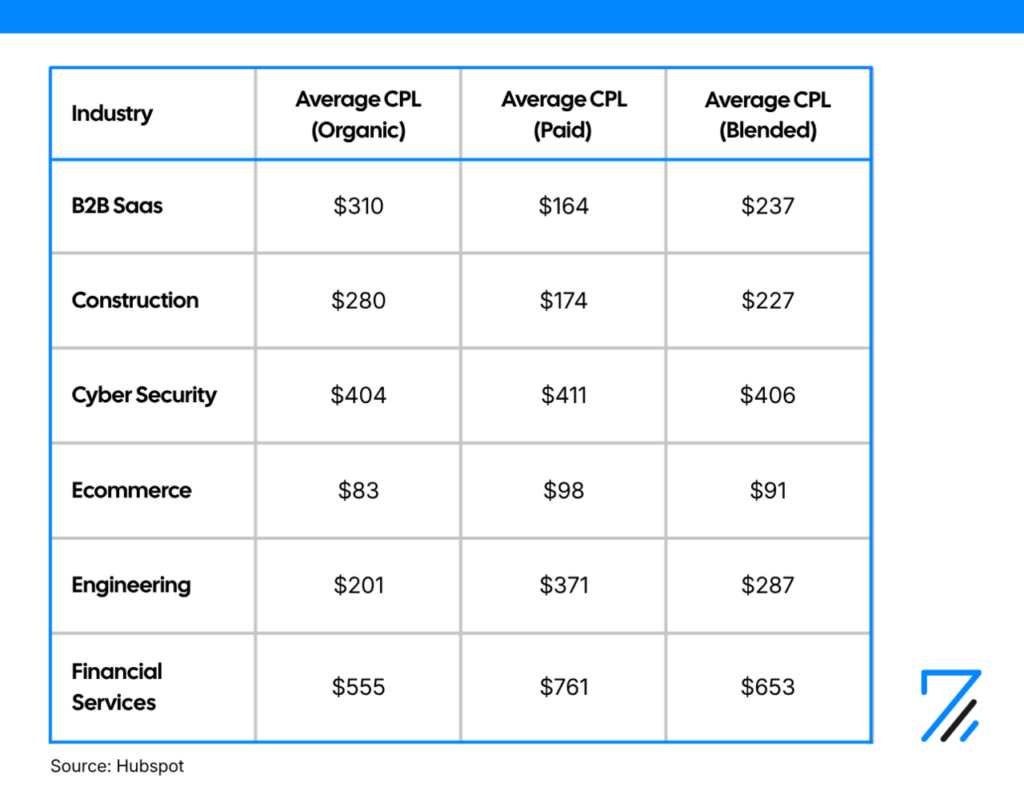
Source: Hubspot
Sales cycle influence
Where did outbound touchpoints appear in closed deals? Which sequences accelerated conversations that were already in progress? Understanding the influence layer, not just the attribution layer, gives GTM teams a far more accurate picture of what's actually driving revenue.
Deliverability health as a lagging indicator of quality
Bounce rates above 2% and spam complaint rates above 0.1% don't just damage campaign performance – they signal that something upstream in the data or targeting model has gone wrong. Clean numbers here are a symptom of good execution everywhere else.
Who Should Move to Managed Acquisition
Not every company is in the same place on this spectrum, and the decision to move toward a managed acquisition model depends on where you are and what you need.
- The signal that the current model is reaching its limits tends to show up in a few consistent patterns.
- Pipeline reviews where activity looks fine but qualified opportunities are thin.
- Marketing and sales operating in separate worlds, each optimizing for their own metrics without shared accountability for revenue.
- SDR teams that turn over faster than they ramp up, creating perpetual restarts.
- CAC that keeps climbing despite consistent outreach effort.
Companies in earlier stages – those still validating their ICP, still learning which messages create momentum – often benefit most from a managed acquisition partner precisely because the feedback loop is faster.
Rather than spending six months building an in-house team before testing assumptions, you can put a structured system into market quickly and learn from real signals.
Companies in growth stages, where the bottleneck is pipeline volume rather than product-market fit, benefit from the scalability and specialization a dedicated acquisition engine provides – without the management overhead of scaling an internal team.
Enterprise organizations building into new segments or geographies benefit from the speed and localized expertise that outsourced acquisition partners can deploy without the friction of internal hiring across markets.
One example profile that probably doesn't fit: companies with deeply technical, long-cycle, relationship-driven sales where institutional product knowledge genuinely can't be replicated externally.
For everyone else, the question isn't really whether a managed acquisition model can outperform the current approach. It's whether the organization is ready to measure it honestly.
The Shift Worth Making
Lead generation, as it has existed for the last decade, was a volume problem dressed up as a strategy.
The real problem was always quality: quality of data, quality of targeting, quality of timing, quality of outcomes measurement.
In 2026, the teams that are building real pipelines aren't the ones generating the most activity. They're the ones who have accepted that acquisition is a systems problem, not a headcount problem, and built their motion accordingly.
If any of this resonates (if your current approach feels like it's working just enough to keep going without ever quite working well enough to scale confidently) it may be worth taking an honest look at whether your acquisition model is built for the market you're actually in.
Zeekeo helps B2B teams build structured, outcome-driven acquisition engines that combine ICP definition, enrichment, multi-channel sequencing, and continuous optimization into a unified system. If you're evaluating whether your current outbound model is future-proof, we're happy to take a look together.
Subscribe to our blog
Lorem ipsum dolor sit amet, consectetur adipiscing elit. Pellentesque eget nunc finibus, venenatis purus eget, porta enim. Fusce a tempor diam, sed consequat purus.

Richard Lloyd
Richard Lloyd is the Chief Operating Officer at Zeekeo, the leading platform for B2B lead generation and multichannel outbound sales. With over 20 years of experience in customer success, account management, and operations, Richard focuses on building scalable systems that drive growth, efficiency, and exceptional client outcomes. He combines data-driven leadership with a commitment to quality and customer experience, ensuring every partnership delivers measurable value. When he’s not optimizing systems, you’ll find him cooking, baking bread, or hiking with Jasper, his spirited Fox Terrier.